Mental Illness and Gun Confiscation

At this point, I have not been able to find the actual wording of New York’s new law or the federal government’s proposals; but I have some questions based on the information that I have found.

In general, the concept is that if a person is mentally ill, and a health care professional believes that he poses a threat to himself or others, the doctor must refer the matter to a supervisor, who will determine whether or not the threat is serious.  If he determines that it is a real threat, he is obligated to notify the appropriate police authorities, who will confiscate the patient’s guns.

  • Apparently, the NY law specifies only threats that mention using a gun illegally.  Will this be expanded to include all terroristic threats, which can be verbal, nonverbal, written, or even implied by body language?  If my doctor thinks I’m pointing a finger at him like a gun, can that result in my guns being taken?  (Or maybe they should amputate the finger?)
  • How are the doctor or supervisor supposed to investigate the threat to know whether it is serious?  Once they report to the police, do the police have to conduct their own investigation?
  • Will police need a search warrant to enter my house and take my guns?  Will the doctor’s word be enough evidence to obtain one?
  • Will there be a trial or other hearing to which I could appeal and potentially get my guns back?
  • How long will the report–even a false one–remain on file?
  • What if the guns in the home belong to someone else, like my wife or mother?  Are the police justified in confiscating them?
  • What if I make a threat to use a friend’s gun that is not stored in my home?  Can officials take it away from my friend?
  • What if I say I intend to buy a gun legally and then use it illegally?  Can it be confiscated from the seller?  (Remember, I don’t need a background check to buy from a family member.)
  • From what I can tell, doctor-patient privileges or HIPAA requirements do not apply in cases like this, even though they apply if my underaged daughter gets an abortion.  So what happens if my daughter has an abortion, and then suffers such guilt and remorse that she threatens to shoot herself with my gun?  Does that mean that the police can take my gun away, but they can’t tell me why?

When I was at my lowest, my thoughts of suicide never involved any of my guns–they always involved my car.  I wonder if the police will pay off the loan after they take that away from me.

Scriptural Principles for the New Year

Here is a brief summary of a New Year’s sermon I have preached in the past.  All references are from Joshua 4 and 5.  I will let you fill in the details.

How to Get a New Start

Seek and follow godly advice.  (4:4-5)

Don’t go back to the old way, but remember how God brought you out. (4:19-24)

Make your relationship with God public, and then maintain a consistent testimony.  (5:2-8)

Renew your dedication to God’s ways–His commands, His principles, His wisdom.  (5:10)

Stop relying on the blessings of the past.  Seek–pursue–acquire–assimilate the new blessings God has prepared for you.  (5:11-12)

Seek wisdom in quiet moments.  (5:13a)

Test the spirits, but follow God’s leading with conviction and courage.  (5:13b-15)

May God establish you in your new year; tear down the walls that obstruct you; and give you victory in every endeavor for Him.

Interesting quote

clarence darrow pleaded for the life of leopold and loeb.  he said:

why did they kill little bobby franks?
not for money.
not for hate.
they killed him
because somewhere
in the infinite processes
which go into the the making of the boy or the man
something slipped.

something has slipped

not only in chicago.

something has slipped in towns everywhere across america,

in maine and in kansas,

in oregon and indiana and vermont,

something has slipped and as a result

we are all

sliding

back toward the dark ages.

–Karen Hesse, Witness, 2001.


Stephanie Goes to Church

 This is a special edition of the Fairly Tales–special for two reasons:  it celebrates Christmas, and it celebrates faith.  Merry Christmas!

Anchor-Christmas-Pageant-2010-049-CopyOnce upon a time there was a fairly named Stephanie who had never been to church.  I know, that seems really strange to us because we have so many churches that we can go to, but we have to remember that fairies are imaginary, and leprechauns are imaginary, so it makes sense that their fairlies and leprefauns would be imaginary too.  And you don’t find very many imaginary things in church—at least, I hope you don’t.

But one Christmas time, the church down the road from the sugar bush was having a Christmas pageant for everybody in the neighborhood.  Have you ever been to a program where they had Mary, and Joseph, and a doll in a manger, and lambs and donkeys and shepherds and angels, and everybody sang songs and got a box of candy when it was all over?  If you’ve never seen one, you’ll have to make plans for next Christmas, because they’re pretty special, and the candy is good, too.

But getting back to the church down the road:  Stephanie’s mother tried out for the part of the main angel, and nobody recognized her as the tooth fairy, but everybody just thought she was already in an angel costume with the wings and all, so she got the part.  And Stephanie was jealous.

“Mom,” she whined, “if you’re the maingel, can’t you have assistangel?  I’ve got wings too, and I would help you say all the angel stuff like ‘Hark!’ and ‘You better be good, cause I’m watching you!’”

Stephanie’s mother was so patient it’s sickening.  “First of all, I’m the main angel, not the maingel, and the people in the church have already picked all the other angels they need.  Besides, you have green hair, and angels are supposed to have brown hair, so you can see their halos better.  And what do you mean about angels telling people to be good?”

“Well, whenever it looks like I’m going to get in trouble, you say you hope the angels are watching me.  I figure they’re like invisible policemen,” Stephanie replied.

“More like rescue squads,” her mother said under her breath.  “But anyway, I have an idea how maybe—just maybe—you can be in the pageant too.  I’ll check tonight at practice.”

Stephanie did her happy dance until her feet weren’t happy any more, and then she did her happy sit down and tried to concentrate on the present she was making for Grammie.  (She knew that Grammie liked cats, so she was trying to build one out of cattails, pussy willows, and caterpillars.  She had picked some catnip, but didn’t use it because she didn’t want Grammie to get bitten.)

She worked all the time her mother was at practice, and had just finished cleaning up her kitty litter when she heard the back door open.  Her mother appeared with a bundle under her arm and smiled as she held out the package to her fairly excited daughter.

Stephanie opened the bag and looked in, and all she saw was a bag of white.  But when our little fairly reached in, she pulled a furry piece of cloth with a zipper and a tail—what do you suppose it was?  It took her a moment, but finally Stephanie realized that she was looking at a lamb costume.  “I’m a lamb?” she asked sheepishly.

“It will be a sacrifice, but I know you can be the best lamb in the whole pageant,” her mother said.  “Besides, it was the only costume they had left that would hide your wings and your green hair.”Anchor-Christmas-Pageant-2010-044-Copy
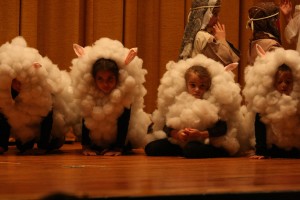
“But no one will know who I am!”  Stephanie protested, even while she was trying to figure out how to put on the costume.  “My first performance, and no one will be able to see me.”  She zipped up the belly and looked at her mother.

“I would know those big brown eyes anywhere,” replied her mother, proudly.

Stephanie turned a couple of circles, trying to see all the way around herself.  “And I’ve got a tail!” she said finally.  “How am I supposed to sit down?”

“Don’t worry about the tail, honey.  Just try not to set your butt on the buttons, or you might become undone.  Now let’s practice your line,” her mother said, putting her arm around her favorite little Christmas lamb.

“My line?  I only have one line? Bah!” the little fairly complained, using a word she had learned from her Uncle Ebenezer.

“That’s enough practice,” said her mother.  “Now if Mr. Paul asks you to say your line, just say it.”

“Who?”

“No, not who!  You’ve only got one line, so don’t mess it up.”

Stephanie had no idea what her mother was talking about.  “Bah,” she repeated. 

“Now you’ve got it.  But you need to wear black on your feet, so you’ll have to wear your toe shoes,” continued her mother, referring to what she wore for her tap dancing lessons.  “I’ll be wearing my heels.”

Well, as you can imagine, Stephanie was at least half a foot confused, so she changed the subject.  “I think my antennas are wrinkled inside this costume.”

“Don’t worry about it—a little extra iron in your diet will straighten everything out,” her mother replied.  “Now—let’s get something to eat so we can go to bed early and be all rested for tomorrow’s pageant.”

“Bah,” said Stephanie.

“Very good,” said her mother.  Stephanie didn’t know what she was being praised for, but she was happy that her mom was happy, so she took off her lamb costume and went to get a salad for supper.

The next day passed much too slowly, but finally it was time for the main angel and the confused lamb to enter the church for the pageant.  Stephanie’s mother made her put her costume on before they got to the church, so that no one would recognize her.  They went in the back door, where everyone else was gathering, and Stephanie was amazed.  There were cows, and donkeys, and other lambs, and boys in bathrobes, and girls in white nightgowns, and three funny-looking guys with crowns on their heads.  A woman was asking in a loud whisper, “Who has baby Jesus?  Mary, do you have baby Jesus?  Keep him inside your robe until it’s time to put him in the manger.  And Joseph, this time just knock on the inn door—don’t knock it over, OK?”

Stephanie wondered if that Joseph was supposed to knock on the out door, too, but she didn’t know who to ask.  “Bah,” she said.

The man in charge heard her and raised her voice a little.  “Lambs, I’ve told you before—don’t say your line until the angel appears and the light comes on.  Do you understand?”  The other lambs nodded their heads, but Stephanie was too confused. She just sighed and sat down on her buttons.

Then the lights went almost out, and there was some talking, and some singing, and Mary and Joseph walked across the stage, and Joseph would have knocked over the inn if Mr. Keeper hadn’t been there to catch it.  And then the cows and donkeys and lambs were all sent out on stage, and Stephanie couldn’t believe her eyes.

There was a whole crowd of people in the long seats, and a few were standing up taking pictures, but the little fairly hardly noticed them.  What she noticed was the beautiful colored windows with pictures on them.  Candles flickered on every windowsill, and green wreaths and red flowers were everywhere.  Stephanie didn’t know that bigginses could make things so beautiful.

Then a bright light came on, and somebody whispered, “Say your line, sheep!” and everybody said “Baa!” except Stephanie, who said, “Who?”  And then she heard her mother’s voice.

“Fear not, for behold I bring you good tidings of great joy, which shall be to all people.  For unto you is born this day in the city of David a Savior, which is Christ the Lord.”

And then there was a lot of talking and singing, and before she knew it Stephanie and the other lambs were herded off the stage, and then her mother guided her out the back door and they were on their way home.

“Did you like the pageant, Honey?” her mother asked as they walked up the dirt road.

Stephanie thought about it for a moment, and said, “I guess so, but I don’t know what it was all about.  It was a little confusing to me.”

Her mother smiled.  She knew that confusion was her daughter’s fairly normal state; but she also knew it was time to tell her something that she had meant to talk about for a long time.  “Did you hear them talk,” she asked, “about the baby Jesus, and my speech about the Savior which is Christ the Lord?”

“I guess so, but I just thought it was part of the play,” Stephanie replied.
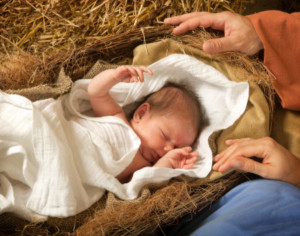
20 days old baby sleeping in a christmas nativity crib“It was part of the play, but it was the most important part,” her mother began.  “Once upon a time, there was a great big powerful person named God who made the whole world, and all the animals, and even the bigginses.  And then He sent His son out of the sky into the world so that everyone could be happy and could live with Him forever.  That son is Jesus, the Savior and Lord that I talked about.  He was born as a baby many, many years ago, and Christmas is His birthday.”

Stephanie was puzzled.  “You said he made the bigginses—did he make us, too?”

“No,” replied her mother, “you have to remember that we’re imaginary.  The Maker in the sky created bigginses with imaginations, and they created us.”

“But you said that Christmas is Jesus’s birthday—what about Santa Claus?”  Stephanie didn’t ever remember getting presents from some baby Jesus, so her mother’s claim had scared her a little bit.

“We’ll talk about Santa Claus another time when you’re a little older,” her mother said.  “But for now, you need to know that Jesus is as real as real can be, and anything good or beautiful in the world comes from Him, and you need to learn to love Him just like you love me.  And tomorrow is His birthday, which makes us so happy that we give presents to each other; and that’s what Christmas is all about.”

And Stephanie kept all this things, and pondered them in her heart.

Now, I know that Joshua, and Dawson, and Emilie all know a little bit about Jesus, but today would be a good day to ask Daddy or Mommy more about Him, and what it meant when the angel called him “Savior” and “Lord”.  When we have birthdays, we turn 6, or 7, or 8, (or maybe 30 or even older!), but this year Jesus is older than parents and grandparents and aunts and uncles and cousins and Christopher Columbus all put together.  And He’s still alive, and having a birthday every year.  Happy birthday, Jesus!

And next time, if the jello doesn’t mold and the turkey doesn’t lose its stuffing, I’ll tell you how Stephanie Learns a Lesson.

The Christmas Story in the Gospel of Matthew Part 2–Answers

I fully expect some of these answers to be controversial.  Between competing traditions and the attempts to explain miracles scientifically, we have all been programmed to be a bit defensive about the timing and means of God’s workings in Matthew 2.  Here are the best answers I can find from the Scriptures, history, and reasonable speculation.

  1. Matthew 2:1 When were the days of Herod the King?

Not all historians agree, and the changing of the calendar from Julian to Gregorian confused the issue, but the best research shows that Herod died in late March or early April of 4 B.C.  These events occurred near the very end of his life—my best guess is that the magi arrived in late winter of 4 B.C.


  1. Who were the Wise Men from the East?  How many were there?

The Greek word for them comes directly from the Persian word magoi, referring to people highly trained and widely respected for their knowledge in astronomy (and perhaps astrology).  They would have been relatively wealthy, and would have been considered wise men indeed.  They came from the East (of Israel), which would agree with their identification as Persians.  If that is the case, they would have traveled 900-1,000 miles—a journey of 2 months or less.  They were certainly NOT kings, and we only know that there were more than 2—because they brought 3 gifts, the myth has arisen that there were 3 magi named Caspar, Melchior, and Balthazar, and that one rode a camel, one rode a horse, and one rode an elephant.  Some nativity scenes portray this, and the myth is carried on even in popular literature such as Ben Hur.


  1. Why did they go to Jerusalem instead of to Bethlehem?

They may not have known Micah’s prophecy, and in any case the place for a “king” is in the capital city.  Apparently they were not discrete in their inquiries, for soon all Jerusalem was aware of their arrival and purpose, and word got to Herod indirectly—not from them. 


4.   v. 2 How did they know the prophecy about a star, and why did they associate it with a King of the Jews?

They must have known the prophecy in Numbers 24:17 and its relation to Genesis 49:10.  It is possible, though less likely, that they knew Isaiah 60:1-3—less likely because they probably knew the books of Moses from Daniel’s tenure and ministry among the magi in the Medo-Persian Empire about 550 years earlier, and we have no indication that Daniel (or his companions) knew the prophecies of Isaiah.


5.   v. 3 Why would Herod, the “King of the Jews,” NOT know the prophecy about Bethlehem? 

He was not an educated, trained, or practicing Jew.  Exposure to the Scriptures came from attendance at synagogue or temple, and he certainly did not attend either—let alone have a private tutor to educate him in the teachings of the rabbis.  Though he claimed to have some Jewish heritage, he was thoroughly Romanized.

Even if he had known the answer, the question itself may have given Herod the opportunity he wanted to gather all the chief priests and scribes together in Jericho, where he had them locked in the Hippodrome (horse track/coliseum).  History records that shortly before his death, he had them locked up with orders that they be killed upon his passing, so that there would be mourning in the land instead of the rejoicing he feared would happen at his death.  Fortunately, his orders were not carried out, and the men were released instead.


6.  v. 6 How does Micah describe the Messiah?

The reference partially quoted  by Matthew comes from Micah 5:2 and following, where He is described not only as a ruler in Israel, but as an eternal King who will leave and then return to rule the whole earth.


7.  v. 7 What one question does Herod ask the magi?  What is their answer?  (Compare v. 16)  What is the significance of their answer?

This is one of the most misunderstood aspects of the Christmas story, which makes my comments controversial.  Herod asks the magi when the star appeared, and we don’t know what they told him.  Based on whatever they said, Herod chose the 2-year time frame for the execution of the baby boys in and around Bethlehem.  As a result, most Bible readers, preachers, and scholars have assumed that their answer to Herod was “2 years”, which logically makes no sense whatever.  Herod wanted to be sure to kill the baby king, so he included all the boys two years old and under—not just those two years old.  It is inconceivable that he would choose to include those younger than the magi indicated, but ignore those older.  Any crafty king (and Herod was crafty indeed) would have included anyone remotely possible as the baby in question; so the most logical conclusion is that the magi said that the star appeared one year earlier.

The other assumption that most people make is that the star appeared on the night that Christ was born, even though there is no Scriptural reason to assume that.  In reality, the star appeared twice (see vv. 9-10)—which appearance marked the birth?  It is just as reasonable and Scripturally justifiable to assume that the star first appeared before Christ was born, in order to start the magi on their journey; just as it appeared the second time after He was born, to lead them to their destination.


8.  v. 8 Why do you suppose Herod sent the magi alone to Bethlehem, instead of soldiers?

We can only speculate; but given his distrust of everyone around him, (and especially so if this was very close to the end of his life,) he might have suspected that the guards might be won over by the teachings of the magi, or the presence of the Messiah.  It is also possible that the magi refused the escort, and Herod did not want to offend his only means of finding the child—though in that case, he probably would have had them followed by his spies.  Perhaps he considered them fools and didn’t believe their message until they disobeyed by not returning.  The fact that Herod sent the magi out by night indicates that he did not want anyone from Jerusalem joining them, and that he probably had a curfew enforced by guards, which depleted his numbers.  Perhaps God used his mental and physical condition to distract him from being thorough.  (We know from history that Herod attempted suicide 5 days before his death.)


9.  v. 9 What evidence is there that the star was miraculous and not merely an astronomical oddity?

It appeared when they were in the East, and at some point it disappeared.  (The Bible never says that they followed it to Jerusalem.)  There is no indication either Scripturally or historically that anyone else ever saw the star.  It reappeared when they were ready to leave Jerusalem (thus their joy when they saw it again).  A natural astronomical oddity could have guided them southward toward Bethlehem—but only a miraculous star could have indicated one particular house.


10.  v. 11 Where did they find the Christ?  Who was there?  How old was Jesus?

In a house in Bethlehem.  While Jesus and Mary were present when they arrived, it is clear from v. 13 that Joseph was there before they left.

The age of the Christ child has been caught up in the misunderstandings of the timing of the star and Herod’s order to kill the babies 2 years old and under—we are often told that He was two years old when the magi arrived.  This is often “supported” by the use of the word child in vv. 11, 13.  In reality, the Greek word used in those verses is the same word used to describe Jesus when He was a newborn (Luke 2:16-17) and when he was 8 days old (Luke 2:21).  John also used the word to refer to a newborn (John 16:21)  Without that linguistic support, and IF the star first appeared at His birth, He would probably have been about a year old.  However, it makes no sense that Joseph would have stayed in Judea for a year or more.  (It was not to hide the timing of Mary’s delivery, since she was already “great with child” when they left Nazareth.) 

And it is inconceivable that Mary, Joseph, and Jesus could have appeared to Simeon and Anna in the temple without anyone knowing about it—especially with Anna spreading the word (Luke 2:38); so Jerusalem was already beginning to buzz with talk of the Messiah before the magi arrived, though the gossip had not yet reached Herod in Jericho (even with his network of spies).  The most reasonable conclusion is that Jesus had been presented in the temple just days (or even hours!) before the magi arrived—and Jesus was 40 days old when He was presented.  It is logical to think that Jesus was no more than 2 months old when the magi came.


11.  v. 11 What is the significance of the gifts?

Gold signified royalty; frankincense was used in the worship of Jehovah God; and myrrh was associated with death and burial.  Jesus was Divine King and our Perfect Sacrifice.


12.  v. 12 Why do you suppose God spoke to the magi in a dream, instead of using the star?  How did they respond?  What does this say about the spirituality of these scientists?

It probably would have confused them if the star appeared again.  What would it mean?  Should they follow it?  Did it indicate another king?  A dream from God was much more direct, especially when they were in a worshipful and spiritually receptive mode.  They obeyed implicitly and immediately, as we all should.


13.  v. 13 Where was Joseph told to go, and for how long?

He was told to go to Egypt until he heard from God again.  He was not told that Herod would die—only that he would seek to kill Jesus.  We have no idea how far into Egypt they went, but there was no reason for them to go as far as Alexandria or Thebes.  It is reasonable to assume that they went only far enough inside the border to be safe from Herod’s forces, who could not cross into Egyptian territory without creating an international incident.  As early as the 5th Century, 2 sites in Cairo were claimed to be locations related to the exile, and were visited by pilgrims as such.


14.  v. 16 When did Herod send his soldiers to Bethlehem?  What were their instructions?  Why do you suppose that this episode is not recorded in history apart from the Bible?

He waited until it was obvious that the magi were not going to return, which indicated their deliberate disobedience and his own failure to oversee them. This would have happened within days—a little longer if Herod was distracted.   However, he does not send troops to catch and kill the magi; by this time he was convinced that the recently-born “King of the Jews” was a greater threat, and ordered the soldiers to kill all baby boys in and around Bethlehem 2 years old and younger.  The number of babies and children is unknown, but would have been fairly small, since Bethlehem was a small village.  Even so, it would have been reported among the long list of Herod’s depredations, unless it was completely overshadowed by a far more significant event—such as the death of Herod himself.

Though tradition in the Greek Orthodox church claims that 14,000 children were killed, that number far exceeds the total population of the village, which was probably no more than 2,000 people.  Based on that figure, the number of murders would have been around 20 or 30.


15.  vv. 19-22 How did Joseph know when to leave Egypt, and where to go?

Sometime not long after the death of Herod, an angel appeared to him in a dream and told him to return to Israel.  The normal route to Nazareth led through Judea, but Joseph was wisely afraid of Herod’s son, and God instructed him to take a detour to get back home.  (It almost sounds like Nazareth is a new location for the family; but actually Matthew had never mentioned where they were from, and chooses to identify the town at this time in order to link it to a prophecy.


16.  v. 23  Where does the prophecy regarding the Nazarene come from?

Isaiah 11:1 refers to the coming Messiah as a branch, which is the Hebrew word netzer.  Apparently there was a rabbinical school that interpreted this to mean that He would come from Nazareth.  (The kabala believed in by so many celebrities today comes from the unique interpretations of just such a mystic group.)   Though the followers of this particular sect had taught this prophecy (justifying Matthew’s referring to the prophets), the teaching was apparently not widely known or believed.  Compare John 1:46 and 7:41, where the speakers express their doubt that Messiah could come from anywhere in the Galilee, let alone the village of Nazareth.

Gun Control, Public Safety, and Reality

The President says we cannot tolerate this kind of gun violence any more.

Has he been tolerating it?  I haven’t–THERE IS SIMPLY NOTHING I CAN DO ABOUT IT.

Wickedness, evil, murders and madness.  They have always been with us, and they will always be with us.  Even in Christ’s peaceful 1,000-year reign on earth, there will be criminals who are punished and executed.  So what makes us think we can stop them?

In reality, gun violence and mass murders have DECREASED over the last few decades (the peak was in the 1920’s).  Why do they seem so much worse today?  Wall-to-wall media coverage.

Why was so much false information broadcast on Friday?  Because the media were trying to fill hours of continuous broadcasts to keep viewers from changing the channel.  They reported everything that came their way–right, wrong, or ridiculous.

Gun control is NOT going to solve the problem.  Connecticut has one of the nation’s strictest gun laws; see what happened.  Countries like Ecuador where guns are completely banned have crime rates through the roof.  China has rigid gun restrictions; last week several school children were injured in a knife attack.  America’s worst school violence was not at Virginia Tech or Columbine–it was in 1927 when 3 bombs were used to attack a school.  Oklahoma city and the first World Trade Center attacks were carried out with bombs; 9-11 was perpetrated with box cutters and airplanes.

By the way:  how did the government respond to the dangers revealed by the 9-11 attacks?  By putting more armed security on duty at airports and even on the planes.

One reporter last night said that attempts at gun control would be “complicated” by the second amendment to the Constitution.  Here’s my opinion:  anytime the Constitution is complicating or preventing the action you want to carry out, YOU ARE PURSUING THE WRONG POLICIES.

Can schools be safer?  The schools with which I have been associated have all had similar safety plans to those in place in Connecticut.  That school did everything right, and 26 people died.  What more could they have done?  One historical episode gives me a clue.  Remember a few years back when a gunman tried to get into the Holocaust Museum in Washington, D.C.?  The armed guard inside the door kept the madness from getting any farther than the foyer.

I am actually in favor of limited gun control, to the extent that I don’t see any reason that any citizen needs to have an assault rifle–even for protection.  Ban those like we ban hand grenades, bazookas, ground-to-air missiles, etc.  But beyond that, nothing else is reasonable, possible, or wise.  Are we really going to shut down all the gun shops and sporting goods stores?  Are we going to go door-to-door and confiscate every legal weapon?  (And gun registration is just the means to prepare for gun confiscation.)

The second amendment was written so that people could protect their homes and families–not only from predators, but from overreaching and tyrannical government.  We must not let the sensationalistic media (let’s call it what it is:  today’s yellow journalism) delude the ignorant masses into thinking that the government can solve their problems if we give Big Brother the right to abandon the Constitution. 

We all grieve for the families affected by the recent tragedies–but in reality, the only positive step that schools could take to make their institutions safer would be to put armed guards at the doors.  And by the way–don’t ask the federal government to help fund this one practical and effective measure; THE CURRENT ADMINISTRATION HAS QUIETLY ELIMINATED FUNDING FOR SCHOOL SAFETY INITIATIVES FROM THE FEDERAL BUDGET OVER THE PAST 4 YEARS.

I don’t like being a fatalist, but here’s my closing thought:  the most effective measures to decrease violent crimes in America are to enable an economy that creates real jobs, and to teach our children to love God, respect authority, and recognize their place in society.  But I don’t see either of those things happening any time soon.

The Christmas Story in the Gospel of Matthew (Part 2)

Last time, we read between the lines and used Scripture, history, and our sanctified imaginations to examine Matthew chapter 1.  This week we look at chapter 2.  Answers to follow in a few days! 

WARNING!  THIS POST MAY CHALLENGE WHAT YOU “KNOW” ABOUT THE CHRISTMAS STORY!

The Christmas Story in the Gospel of Matthew  Part 2

1.  Matthew 2:1 When were the days of Herod the King?

2.  Who were the Wise Men from the East?  How many were there?

3.  Why did they go to Jerusalem instead of to Bethlehem?

4.  v. 2 How did they know about a star, and why did they associate it with a King of the Jews?

5.   v. 3 Why would Herod, the “King of the Jews,” NOT know the prophecy about Bethlehem? 

6.  v. 6 How does Micah describe the Messiah?

7.  v. 7 What one question does Herod ask the magi?  What is their answer?  (Compare v. 16)  What is the significance of their answer?

8.  v. 8 Why do you suppose Herod sent the magi alone to Bethlehem, instead of soldiers?

9.  v. 9 What evidence is there that the star was miraculous and not merely an astronomical oddity?

10.  v. 11 Where did they find the Christ?  Who was there?  How old was Jesus?

11.  v. 11 What is the significance of the gifts?

12.  v. 12 Why do you suppose God spoke to the magi in a dream, instead of using the star?  How did they respond?  What does this say about the spirituality of these scientists?

13.  v. 13 Where was Joseph told to go, and for how long?

14.  v. 16 When did Herod send his soldiers to Bethlehem?  What were their instructions?  Why do you suppose that this episode is not recorded in history apart from the Bible?

15.  vv. 19-22 How did Joseph know when to leave Egypt, and where to go?

16.  v. 23  Where does the prophecy regarding the Nazarene come from?


By Request: What Nuts Can Teach Us About God

Last week, I presented an object lesson about culinary nuts, and some lessons we can learn from them.  A number of kind people have asked me to post my notes, so here they are.

There are three kinds of nuts identified in the Bible:

1.  Almonds–They teach us of God’s Favor

  • Numbers 17:8  When God wanted to identify His choice for the people of Israel, He had Aaron’s rod not only bud and blossom, but to produce almonds.
  • Ecclesiastes 12:5  The almond blossom is used as an analogy for white hair, which is a sign of God’s blessing (Prov. 16:31)
  • Exodus 25:33-34  When God wanted to decorate the Holy Place of the Tabernacle, He instructed Moses to construct the Lampstand in the form of almond buds and blossoms.
  • Trivia:  the almond is actually a member of the peach family; and because it ripens early and does not keep well, the nuts are usually pickled in brine to extend the shelf life.
  • The almond teaches us that God loves us and will use His own means to demonstrate the things that please Him.

2.  Pistachios–They teach us of God’s Riches

  • Genesis 43:11  Jacob sent nuts as one of the gifts to Egypt–the Hebrew word is specifically the word for pistachios.  These grew in Lebanon and Syria, and thus were expensive and precious.
  • Trivia:  Pistachio trees are male and female–it takes two trees to produce the fruit.  The female tree will produce about 50,000 seeds every two years.  Pistachios were originally dyed to hide the bruising caused by hand picking; today, if they are dyed it is only as a matter of preference.  (When dyed red, they have been marinated in a mixture including salt and strawberries.
  • The pistachio teaches us that God shares with us His riches–every good and perfect gift comes from Him–and, of course, the most precious is Jesus Christ Himself.

3.  Walnuts–They teach us of God’s Comfort

  • Song of Solomon 6:11  The bride goes walking in the garden of nuts–the Hebrew word is the word for walnuts.  Though walnuts were eaten, and their shells were used to make dyes, the chief purpose of walnut trees at the time was for shade.  The walnut garden would have been a cool and beautiful place because of the overshadowing trees.
  • Trivia:  Walnut trees secrete chemicals into the soil to prevent competing vegetation from growing too close and depleting their water or nutrients.
  • The walnut teaches us that God wants us to enjoy this wonderful world in which He has placed us, and to look ahead to the comfort of that heavenly rest yet to come.

Other nuts are not mentioned in the Bible, but can still teach us about God.  Romans 1 tells us that we can learn of God through nature.

4.  Brazil nuts–They teach us of God’s protection

  • It is almost miraculous that brazil nuts exist at all.  The blossom that produces the nuts (seeds, actually) is tightly wrapped into itself, and can only be opened and fertilized by a particular breed of large, strong, long-tongued female bees–but they are not attracted to the blossom.  They are attracted to the smaller male bees, but only after they have interacted with a specific orchid, which does not grow on the tree of the brazil nut.  So God put the orchid near by to attract the male bee, who then moves to the brazil nut blossom and attracts the female, who ends up fertilizing the plant.  That chain of required events did not evolve–it shows Divine intelligent design!
  • In addition, while the nuts are taking 14 months to develop, they must be protected from insects and other jungle creatures, so they grow inside a hard, wooden casing like a coconut shell (8-24 nuts per shell).  This casing also protects them when they ripen and fall to the ground–often a fall of 100 feet or more!  Yet, to propagate the species, God left a hole in the shell, and created a rodent called the agouti who can use its strong jaws and teeth on the hole and open the casing to release the nuts.  The animal will eat some of the brazil nuts, and bury the rest for later.  Because each nuts has its own strong shell, they can last underground for decades–which is good, because they cannot germinate and grow until their planting ground is in sunlit warmth, which does not happen on the jungle floor until a tree falls and lets the sunshine in.  When that happens, then the life cycle starts over.
  • The brazil nut teaches us how God has planned for our protection and our good in every aspect of our lives;  even when we fall, we will not break.  Even when our security is ripped open, we will survive.  And even when we must patiently wait for His next blessing, we know that one day we will thrive.

5.  Cashews–They teach us of God’s ingenuity,  and our creation in His image.

  • Cashews are poisonous–that’s why you NEVER see a cashew in a shell.  The bud and blossom form, then the nut (seed) grows from it, and then a red or yellow fruit grows between the nut and the bud.  This “cashew apple” is edible and highly desired by the people who cultivate them.  (They are too fragile for transport, which is why we never see them in our stores.)  However, the nut itself, now in a hard shell attached to the bottom of the fruit, is highly poisonous until the shell is roasted and removed.  In fact, the roasting must be done outside to prevent the poison from affecting the workers!  Once that is done, however, what is left is a delicious nut.
  • The fruit is edible; so who decided to eat the nut?  Who invented the means for removing the poisonous shell to make it safe to eat?  We will never know.  But we know this:  God is the creator, and He made us in His image–which means that man is creative.  This creativity that comes from our Maker is the source of the curiosity and inventiveness that has made our lives so much easier and more pleasant.
  • The cashew nut teaches us that God wants us to have dominion over nature, and to use the abilities He has given to discover and unlock the secret pleasures He has prepared for us.

We have a Great God, Who has put us in a wonderful world!  Let’s look for lessons about our Creator in everything we see!

Christmas in the Gospel of Matthew–Answers

The Christmas Story in the Gospel of Matthew (Part 1)


Can you answer these questions?  Here are my answers from Scripture.


  1. Why does the genealogy in Chapter 1 start with Abraham instead of Adam or Noah?

          Matthew is writing particularly for the Jews.  He makes this clear by the way he divides Jewish history into 3 time frames, and his use of Old Testament references.  Abraham is the first patriarch of the Jews.


  1. It claims to be the genealogy of Joseph.  What historical evidence does it contain that confirms this?

          Matthew 1:11.  Jer. 22:24-30 declares that no son of Coniah would be a lasting king over Israel; therefore, this must be the genealogy of a parent not related to Christ by blood.


  1. What is significant about vv. 3, 5, and 6?  What do they tell us about God?

          They mention women; women with weaknesses and sins; even gentile women.  God loves all people and includes them all in His grand design—not just Jewish males.


  1. Verse 17 breaks the genealogy into three groups of 14 generations; but the first group covered about 1000 years; the second about 400; and the third about 600.  Is Matthew being literal, or is there some other explanation for his divisions?

          The Greek word for generation can be translated as a period of time, a nation, a rank of descent (genealogy) or even a group of men sharing something in common.  Matthew mentions 14 men in each grouping—the time of Theocracy, the period of Monarchy, and the post-monarchy period—in order to show the divisions of Jewish history.  He well may have left out fathers or sons in order to standardize the pattern of 14 cited in the first division.


  1. What does espoused mean in verse 18?

          Engaged, but with the legal force of marriage.  During this period, often a year, the couple lived separately and maintained chastity, but were each other’s heirs; and the arrangement could only be broken by divorce or completed by the marriage supper.


  1. What is the significance of Jesus Christ being “of the Holy Ghost”?  What major doctrines does this relate to?

          Miraculous conception without participation of a man—therefore, no sin nature, allowing Jesus to die for the sins of others, since He had no sins of His own.  This relates to doctrines regarding sin, salvation, the Trinity, prophecy (remember “the seed of the woman”) and others.


  1. Did Joseph love Mary?  What does verse 19 indicate on this topic?

          Probably, but this verse does not prove it.  His motives are first to protect his own honor, and secondly to prevent her from experiencing unnecessary humiliation.  Any decent man would have done the same—it does not prove his love for her.


  1. Does verse 19 justify divorce?

          Yes—under the specific allowances set out by Moses.  Because Joseph had proof of Mary’s “fornication”, he was justified (though not commanded) to divorce her.  Compare Matthew 5:31-32 and 19:9.


  1. Verse 20 says that “the angel of the Lord” appeared to Joseph.  That term usually refers to the pre-incarnate Christ; did Jesus Himself appear to Joseph before He was born?

          It is possible, but unlikely.  It is an unproven assumption that the term “the angel of the Lord” always means a Christophany.  Apart from the irony of the situation, this appearance does not use “the angel of the LORD” as we find in several other places; also, the Greek language does not use the definite article here so it could just as well be translated as “an angel of the Lord”.


  1. Why did the angel appear in a dream, instead of face-to-face, as with Mary?  Does this tell us anything about Joseph’s spirituality?

          We may never know for sure, but perhaps Joseph was more receptive to dreams and visions than he was to direct prophetic announcement.  He might have responded in disbelief if confronted by an angel face-to-face, just as Zechariah did.  Regardless, he believed God’s message and responded to it, as a spiritually receptive person should always do.


  1. Joseph was told the sex of the baby before it was born.  Is that indirectly a justification for all the prenatal testing and scientific procedures we use today?

          It was a special case, confirming prophecies to him.  It neither commends nor condemns testing for or knowing your unborn child’s gender.  (Obviously, if the knowledge is to be used for the wrong purposes, as it is in China or India, then the wrong motive and subsequent actions would be sinful.


  1. In verse 23, does the word “virgin” mean a virgin, or a young lady, as some translations have it?  What doctrinal significance does the answer make?

          When God told Isaiah to write Is. 7:14, He used a Hebrew word that could mean lass or young lady, or possibly virgin.  The Jews did not hold to the tradition of believing that Messiah would be miraculously born of a virgin—but of a young lady.  However, when the Holy Spirit guided Matthew’s writing, He used a Greek word that can only mean virgin.  By using that word, God was establishing the truth of Holy God taking on the form of sinful man, but without the sin nature, so that He could be the sinless sacrifice for the sin of the world.  A man born of an unchaste young woman would have had the stain of Adam’s sin about him, and could only have died for his own sins.  The doctrine of the virgin birth and all that it implies is strictly a New Testament teaching, fulfilling Isaiah’s prophecy in a particularly specific and powerful way.


  1. What comfort can we take from the fact that all this was spoken of by the prophet Isaiah?

          God has had a plan all along; He has revealed it little-by-little to His servants, and what He has said has come true.  By seeing that God was faithful yesterday in fulfilling His promises, we can trust Him to keep doing what He said He would do today (and tomorrow).


  1. If His name is Jesus, why does verse 23 say He will be called Immanuel?  Did anyone in the Bible ever call Him Immanuel?

          No one ever called Him “Mighty Counselor” or “Prince of Peace” either.  These are descriptive terms, not proper names.  All Scripture writers who taught that Jesus was God in the flesh were indirectly calling Him “Immanuel”.  This can be seen in John 1:14, I Tim. 2:5, and many other places.


  1. What do we learn about Joseph’s character from verses 24 and 25?

          He was obedient to God’s revealed plan for him, even though the new revelation superseded his Old Testament teaching and sense of honor.  He valued Mary and her condition, and voluntarily refrained from consummating the marriage, though that would have caused consternation among many in the community.  He took on the role of protector and foster father throughout her pregnancy, and only later “knew her as his wife” after the prophecy was fulfilled that “the virgin shall give birth”.


  1. If Joseph didn’t consummate the marriage, were he and Mary really married?  Hypothetically, could they have had the marriage annulled?

          Sex does not make a couple married.  The official ceremony (in this case, Joseph’s taking Mary into his home and giving the marriage feast) finalized and solemnized the marriage.  The consummation traditions of the time were more a test of purity than the sealing of the relationship—in fact, the consummation could provide the evidence for a husband to reject his wife and annul the marriage.  The idea that a marriage is not official if not consummated is a medieval tradition intended to justify some arranged marriages (and the related treaties) to be cancelled without a church-forbidden divorce.

The Christmas Story in the Gospel of Matthew

One of my favorite topics to teach about is the Biblical Christmas story.  We all have heard it and read it so often, that we think we know it–and maybe some people do.  But my experience is that when we start to read with a questioning eye and with our sanctified imagination turned on, there is a lot that we can learn about our Savior and His first coming to earth.

This month I will be working through the Christmas story in the Gospel of Matthew with my Sunday School class, and I thought I would post some of the teaser questions here today; next week I will update it with the answers as I understand them.  Remember:  I always start with the assumption that the Word of God as preserved and delivered to us is absolutely, literally true and free from contradiction.  My favorite historical source is Edersheim’s Life and Times of Jesus the Messiah.

Can you answer these questions?

  1. Why does the genealogy in Chapter 1 start with Abraham instead of Adam or Noah?
  2. It claims to be the genealogy of Joseph.  What historical evidence does it contain that confirms this?
  3. What is significant about vv. 3, 5, and 6?  What do they tell us about God?
  4. Verse 17 breaks the genealogy into three groups of 14 generations; but the first group covered about 1000 years; the second about 400; and the third about 600.  Is Matthew being literal, or is there some other explanation for his divisions?
  5. What does espoused mean in verse 18?
  6. What is the significance of Jesus Christ being “of the Holy Ghost”?  What major doctrines does this relate to?
  7. Did Joseph love Mary?  What does verse 19 indicate on this topic?
  8. Does verse 19 justify divorce?
  9. Verse 20 says that “the angel of the Lord” appeared to Joseph.  That term usually refers to the pre-incarnate Christ; did Jesus Himself appear to Joseph before He was born?
  10. Why did the angel appear in a dream, instead of face-to-face, as with Mary?  Does this tell us anything about Joseph’s spirituality?
  11. Joseph was told the sex of the baby before it was born.  Is that indirectly a justification for all the prenatal testing and scientific procedures we use today?
  12. In verse 23, does the word “virgin” mean a virgin, or a young lady, as some translations have it?  What doctrinal significance does the answer make?
  13. What comfort can we take from the fact that all this was spoken of by the prophet Isaiah?
  14. If His name is Jesus, why does verse 23 say He will be called Immanuel?  Did anyone in the Bible ever call Him Immanuel?
  15. What do we learn about Joseph’s character from verses 24 and 25?
  16. If Joseph didn’t consummate the marriage, were he and Mary really married?  Hypothetically, could they have had the marriage annulled?

Do you get the idea?  There’s a lot more to the Christmas story than a baby in a manger.  Visit me throughout the month of December for more questions (and eventual answers) to make this Christmas season a little more Biblical and blessed.

Mental Illness: Public Functionality, Private Incapacity

As I learn more about my own mental illness, I understand more about why people find this affliction difficult to understand in others.  Let me illustrate with a story.

Suppose I were expected to stand up in public to promote an enterprise or a meeting.  Many influential people whom I admire (and fear a little) are watching and listening; I want to–I NEED to–make a good impression.  However, backstage on the way to the platform, I have fallen and twisted my ankle.  I can hardly put any weight on it, and certainly cannot walk on it without excruciating pain.  So what do I do?

I walk across the platform without a limp or a grimace.  I endure the pain with a smile on my face and hope and pray I don’t fall over or pass out.  I make my presentation from behind the lectern, and I am not as energetic as I would have been otherwise, but I conduct myself and my business in a positive and professional (if not exciting) manner.  When finished, I smile and wave and make the long trip behind the curtains without letting anyone see the agony I am feeling.  When I get backstage I collapse and need to be helped to my car, into my house, and straight into bed.  I feel guilty that my audience got my best effort, but my family only gets a suffering shell of myself; so I won’t let anyone help me or make a fuss over me.  My wife is understanding and quietly provides for me and helps me from a loving distance; one of my children pouts when I can’t take him to the ball game, and complains that I always put my family last.  The sting of that attack only makes the ankle hurt worse.

If I try to get up and take the trash out, I may damage the leg even more; if I don’t, the guilt hangs around like a song I heard and can’t get out of my head.

And that’s what my mental illness is like.

I force myself to be functional in public, because I have made commitments I feel I must keep.  I am looking for work, and know I will have to put on a good front if I hope to be hired.  So I push through the pain and despair with a smile on my face and the appearance of normalcy.  When I get off the public stage, I collapse and retreat into the agony and the guilt.  No amount of prayer takes away the pain.  I push people away because I don’t want to hurt them, and I don’t want them to hurt me.  In reality, I look to the doctors and counselors to help heal my crushed spirit, but family and friends sometimes don’t understand why I won’t accept their version of help.

Mondays are the hardest days of the week, because I have used all my mental energy and discipline to be functional in church on Sunday; I have nothing left to give until my emotional batteries recharge a bit.

After months of recovery, medical treatment, therapy, and the rest, I should be better now, right? 

One more illustration:  a person with mental illness is like a flooded house.  The waters may retreat, and you may clean it up and make it pretty again; but the insulation is still wet, the mold is still growing, the wires are still being corroded, the lost items can never be replaced–and you always live with the fear that the flood waters may return. 

My ankle is not twisted, but my brain is.  And, in reality, the two are not as different as I once thought.

An Inconvenient Truth, a Good Testimony

Last night I attended a lecture at the Binghamton Public Library on the topic of Joseph Brant, notorious Mohawk leader.  The speaker was “Buzz” Hesse, who has done a lot of research and archeology on the area, especially regarding prehistory in the upper Susquehanna Basin.  Right from the start he was “politically incorrect”.

Here is a man who discovered and excavated the Iroquois site at Unadilla; who uncovered 4 original letters written by Joseph Brant (one describing the Cherry Valley massacre, one written from Unadilla, and one written from Onaquaga [Windsor]); and who owns the only cannon ever recovered from the Clinton/Sullivan campaign down the Susquehanna. 

Here is a man who gives all the credit to God.

He prefaced his remarks by saying that the things he has been able to do could not be done by a normal person under normal circumstances; and that he is certain that whatever success he has achieved has resulted from God’s blessings.  (The full house sat in tolerant but uncomfortable silence at this declaration.)

He went on to illustrate his point.  As a teen he had discovered half a trade bead on the Sidney side of the river; some 20 years later, at the village site he unearthed across the river, he found the other half of the same bead and recognized it.  He was able to join the two halves (which matched perfectly) and had it photographed and on display.  The odds of that happening are incalculable; it clearly showed the grace of God bestowed on this man’s work.

When he discovered the Unadilla site, it was about to be developed for construction of a new building; he had 4 days to excavate, map, and recover artifacts; then the bulldozers came in.  If he had been one week later, the site would have been lost forever.

Mr. Hesse also pointed out a little-known aspect of Joseph Brant’s character.  This fierce warrior killed dozens (if not hundreds) in battle, but protested the slaughter of women, children, and the elderly; and when he retired from life on the battlefield, he translated and published the Book of Mark in the Mohawk tongue, so that his people could have the Gospel in their own language.  He, too, gave the credit to God.

God does not seem to fit into the modern presentation of history; but He did last night.  It wasn’t a church service, but it was a clear testimony.  Thank you, Mr. Hesse.

Full Circle

The very first article I ever had published (in a college publication) was about man’s regression–how our intellectual capacity is shrunken, compared to that of the ancients.  Now a Stanford professor has come to the same conclusion.  Read it here.

His argument seems to be that civilization’s progress has interrupted “natural selection” [the death of the stupid ones], allowing their brain mutations to persist in the gene pool and contaminate posterity.  His hope is that our science will one day help us to correct mutations and eliminate the downward trend.

My argument was that mankind is progressively affected by sin and its consequences; and we will not get better until the Lord Jesus returns and miraculously changes everything through Unnatural Selection.

Whichever way you want to go, consider this:  as humanity grows dimmer, it is ever more important for us to be lights in our world, to show people the Truth that never mutates or degrades.  That’s the smart thing to do.

Stephanie and the Birthday Party–A Fairly Tale

It has been a while since I have posted; maybe someday I will write about why.  But for now, here is a new installment in the story of Stephanie the Fairly (her mother is a fairy, and her father is a leprechaun).  If you want to go back to the beginning, check with the earliest posts in under this heading.  Astute readers will notice that one of the promised stories has not been posted here.  I decided for personal reasons to reserve that one, at least for now, for the family members for whom the series was created.

These days, most of us know exactly what to expect from a birthday party; but for Stephanie it was a brand-new experience.  Oh, she had celebrated several birthdays herself, as well as a few for her mother, but they weren’t real parties.  There simply wasn’t enough room in the tree house under the maple tree in the sugar bush for a fairly and her mother to throw a party. 


So when she got an invitation to a birthday party for Betty the Brownie, Stephanie was fairly excited.


“Mom, what will they do at the party?” she asked.


“I’m certain I don’t know for sure, but parties usually have games like Pin the Tail on the Biggins, Musical Stumps, or Name that Tuna.  Sometimes they have a piñata.”


“What’s a piñata?”  Stephanie wanted to know.


“It’s a little like a hornets’ nest, but when you hit it with a stick, candy comes out instead of hornets.”


“Sweet!” said her daughter, licking her lips.


Stephanie’s mother went on.  “And then they have some food, and the birthday girl gets to open all her presents.”


Stephanie frowned.  “You mean I have to buy a present to take to the party?  Isn’t my presence there enough?”


“No, dear, you’ll need to take a gift, but don’t worry—I’ve made a special necklace that you can take to Betty,” her mother replied.


So Stephanie went off to play, and to wait impatiently for the big day.


When Betty’s birthday finally arrived, Stephanie got herself ready.  She made sure that her dress was clean, her wings were pressed, and her antennae were dusted.  (After all, she wanted a good reception at the party.)  Then her mother gave her Betty’s gift:  the most beautiful necklace she had ever seen.  It was made of little green cones, strung together on a silver thread, looking like forest pearls.


“Oh, Mom!  It’s beautiful!”  Stephanie exclaimed, slipping the necklace over her head and admiring herself in the mirror.  “Where did you ever get the idea to use hemlock cones like this?”


“What did you expect me to use—old teeth?  Of course it’s beautiful; I’m a fairy!  Someday you too will be able to make everything you touch more beautiful.  But it’s time for you to be going.  It won’t be pretty if you’re late.”


So Stephanie wound her way through the woods and forged her way through the forest until she passed through the hedge of mountain laurel that enclosed the clearing where her friends were gathering for the birthday party.  She saw Betty the Brownie and her mother Fudgie—why her parents ever named her Fudgie I will never know, but I think it’s nutty, myself.  Patty the Pixie was there, along with Diet the Sprite, Ellen the Elf, and many of their woodland friends like Harey the Bunny, Spotty the Fawn, and Joshua the Angry Bird. 


As soon as Stephanie arrived, everyone started talking and chattering and wiggling their whiskers all at once—welcoming her and complimenting her on her beautiful necklace.  She couldn’t remember when she had ever gotten so much attention!  And she liked it.  A LOT.


She liked it so much that she made a bad choice.  I know that Dawson and Emilie have never made any bad choices, but most of us have, at least once or twice. Anyway, I know that bad choices always cause problems later on, but Stephanie wasn’t thinking about later on.  Everyone thought the beautiful necklace was hers anyway, so she decided to keep it for herself.


That bad choice created a problem for her.  If she kept the necklace, she had to find another present to give to Betty, so while everybody else was having Wild Berry Surprise for snacks, Stephanie slipped away out of sight.  But as hard as she looked around, she didn’t see anything that looked even a little bit like a birthday present.  Then, just as Betty’s mother called her, Stephanie had a thought, and she picked up a small stick and headed back to the party. 


Stephanie was very busy as she watched Betty get her presents.  Some were pretty, some were funny, and some were socks.  And while everybody else was oohing and ahhing, the little fairly was rubbing her stick, trying to make it look polished and special.


When it came her turn to give Betty her gift, she pulled out the stick from behind her back and gave it to her friend with a broad smile.  Betty took the stick and looked at her, puzzled.  Stephanie put on her very best “I’m not lying!” face and said, “It’s a whistle—blow on it!”


Betty the Brownie put the stick to her lips and blew.  Nothing happened.  She blew again, harder.  She blew until she turned brown in the face, and was starting to frown when Stephanie spoke up again.


“It’s a special whistle—only grubs can hear it!  I have one for my pet grubs, and they just love it.  Everybody ought to have a grub whistle.”  And Stephanie grinned even more convincingly, she hoped.


“But I don’t have any grubs,” Betty said, a little disappointed by her present.


“Look at it this way,” Stephanie said.  “You’ll be ready when you get some,” and she smiled again, as broadly as she could.


Then Betty smiled, too.  “Hey—that’s right!  This is a very special gift.  Thank you Stephanie; you’re a great friend.” 


(I know it’s a little rude, but somebody has to say it, and you’re all busy reading the story, so I’ll say it myself:  sometimes Brownies are dumber than a stick.)


Stephanie didn’t care why Betty believed her; she was just glad to get away with her sticky little lie.


But when the time came for her to go home, Stephanie realized that she had another problem:  she was still wearing the necklace that her mother had made for Betty.  And that’s when she noticed that her one bad choice was leading her down the path to more bad choices.


She could try to hide the necklace from her mother, but she didn’t know where she could hide it.  She couldn’t put it in her pocket, because fairlies don’t have pockets.  And she just wasn’t very good at being sneaky around her mother.  (There was that episode with the cell phone, but that was a bad call all around.)


She could go back and tell Betty the truth and give her the necklace, but then everybody would know that she was a little selfish and a big fibber.


She could go home and tell her mother the truth, but her mother would punish her and then make her go back and tell Betty, and you know the rest.


Or she could throw her pretty new necklace away and hope that her mother never found out what she had done.  And that’s what she did.  She took off the necklace and turned around and threw it as far as she could, and went home feeling a little guilty and a lot sorry that everything turned out so badly.  She acted so sad when she got home that her mother thought she must have gotten sick from too much junk food at the party, and she made her go to bed.  And her mother never knew what happened.


That is, she never knew what happened until the next day, when Betty the Brownie came to bring Stephanie a thank-you card for the grub whistle, and to give her the necklace that she found along the way.  And she answered all of Stephanie’s mother’s questions.


And Stephanie ended up NOT having the necklace, AND she got punished by her mother AND she had to tell Betty the truth AND everybody knew that she was a little selfish and a big fibber which made Stephanie very, very sad.  But eventually she admitted that her problems all had grown out of the bad choice she had made; and she decided to try never to do anything like that again. 


And that was a very good choice.


Next time, if my fingers don’t fall off and my toes don’t get too full of lint, I will tell you the story of Stephanie and the Chicken Pox.

Mental Illness’s Mixed Messages

I have not written about my mental illness for a while–oh, it hasn’t gone away, but it has just made itself difficult to express.  Here are a few random observations:

  • Disappointment and criticism have a devastating effect on my emotional and physical state; but my sensitivity to my own failings makes it hard to accept praise or encouragement.  It is almost impossible for me to go into my old business–not because people despise me, but because they are so enthusiastic and happy to see me.
  • As lonely and in need of friends as I am, I avoid seeing or calling people I know and that I know care about me.  When someone says, “It’s been so long…” my mind goes into guilt mode; but the longer I avoid people to escape the stress and guilt, the more guilty I feel. 
  • Our (unheated) back porch has been my sanctuary for the past several months–a place where I could get away from things that attack me at home, and where I could take my mind off things with jigsaw puzzles, Wii, satellite radio, and the occasional video.  With colder weather coming, I need to convert my study upstairs into my “winter sanctuary” but I have no hope that it will serve the purpose; so both places have become symbols of despair.
  • My bitterness toward some people contributed to my breakdown, and part of my therapy is to become strong enough to clear the air.  At the same time, the offenses were real and not perceived; and confrontation could be more destructive than restorative.  It may be difficult for me to speak the truth in love; but for some people it would be even more difficult to hear the truth and believe it was spoken in love.  And the cycle–and the downward spiral–would continue. 
  • Do I need to forgive someone whose greatest offense is bringing unnecessary stress into my life?  Or do I just need to learn to cope with it?  Are they at fault for stressing me?  Am I at fault for being stressed?  Am I at fault for being stressed at being stressed?  I have heard it said that a phobia is the fear of being afraid of something; is mental illness the stress at being stressed and the guilt at feeling guilty?
  • I wish some people were heretics, because the Bible says I could reject them after a couple of warnings; but my challenges are not heretics.  They are just difficult or toxic people.
  • Family members have generously paid so that I could join a gym and get my hunting license.  Now, if only I had the energy and motivation to take advantage of either of these great opportunities….  I know I would feel better for doing them, if only I could do them.

Lord, help me to be more loving and forgiving.  Help me to bear all things and endure all things.  And help me to enjoy some things.  Amen and Amen.